
Chances are you probably have never heard of the ketogenic diet. However, chances are pretty good you’ve heard of the Atkins diet – well, the ketogenic diet is similar to the Atkins diet; they both restrict the amount of carbohydrates consumed, and shift metabolism into a state called ketosis.
Ketosis is often confused with diabetic ketoacidosis, a dangerous side effect of uncontrolled diabetes. Despite being relatively unknown, many experts consider ketosis to be a natural and healthy physiological state – even going as far to say ketosis has been mankind’s default condition throughout our evolutionary history, and that being inundated by cheap carbohydrates, as western societies are today, is not conducive to our physiology, ultimately manifesting in a plethora of health problems.
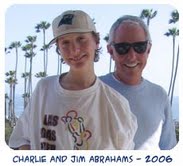 Ketosis occurs when the body runs out of glucose reserves and is forced to manufacture molecules called ketone bodies to replace glucose as fuel. The ketogenic diet was first recognized for its ability to significantly reduce the seizers caused by epilepsy. This lead to the 1997 television movie “First Do No Harm”, inspired by Hollywood director Jim Abrahams son Charlie, and his battle with epilepsy. In search of help, Jim and Charlie spoke with 5 neurologists, not a single one of them recommended the ketogenic diet, even though it had proven itself to be an incredibly effective treatment. The ketogenic diet was able to rapidly control Charlie’s seizures, releasing him form what his father described as a “fate worse than death.”
Doctors have yet to figure out how the ketogenic diet reduces seizures, all that is know is if the drugs typically prescribed to suppress seizures fail to work, the ketogenic diet typically does work.
The ketogenic diets success in treating epilepsy piqued researchers curiosity; they wondered if the diet could alter the course of other neurological diseases. Turns out it can, and does — ketosis has also been proven to reduce the symptoms of Alzheimer’s, Parkinson’s, and can even reduce the damage of traumatic brain injury. Again, there is speculation as to how the diet is capable of reducing the pathology of such a broad spectrum of neurological diseases, but it remains speculation – the mechanism of action has yet to be conclusively determined.
We do know that ketone bodies facilitate some remarkable biochemical changes in the cell. First, ketone bodies increase the overall energetic state of cell. Ketone bodies have a higher energy of combustion, and as a consequence provide more energy when burned. Additionally, ketone bodies burn more efficiently, requiring less oxygen per unit of energy produced. Second, ketone bodies alter the chemistry of the cell, reducing indigenous generation of free radicals. Finally, ketosis increases the concentration of glutathione (glutathione is the cell’s main defense against free radicals) within normal cells, increasing their ability to neutralize free radicals generated from an endogenous source (chemotherapy and radiation). Overall, ketosis appears to be very beneficial for normal cells, providing them with a more efficient energy source while increasing their defenses against free radical assault. This is why many experts’ refer to ketone bodies as “superfuel.”
The “Therapeutic Zone”
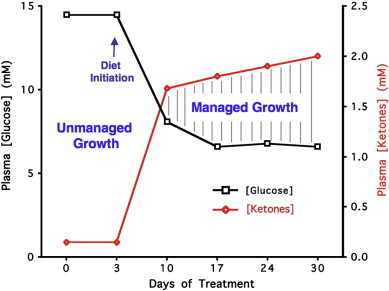
With respect to cancer a Restricted Ketogenic Diet (R-KD) has been shown to have many remarkable qualities. The diet typically consists of a 4:1 ratio of fat to protein, with negligible carbohydrates. There are many helpful recipes and techniques used to achieve the desired ratio. In order to provide the most benefit for people suffering from cancer, the diet has to be restricted with respect to total caloric intake. Everyone has different metabolic rates, and would require different quantities of total calories consumed per day on the R-KD. The goal is to restrict the diet until the patient is in a state referred to as the “therapeutic zone” — consisting of a blood glucose measurement of 55 to 65 mg-dl, and beta-OHB ranges between 4 and 7 mM.
The therapeutic zone, once achieved and maintained, has been shown to alter cancer in important ways. First and most obvious, by restricting the amount of glucose cancer cells have access too, tumor growth rates are decreased. Also, restricting access to glucose impairs the ability of the tumor cell to reduce glutathione, reducing the capacity of the cancer cell to neutralize free radicals, putting the cancer cells under two forms of stress, energetic stress, and oxidative stress. This is important because some cancer treatments kill tumor cells through the generation of free radicals, and the R-KD puts tumor cells in a much more vulerable condition. Second, because normal cells can utilize ketone bodies as energy, and tumor cells cannot, a therapeutic differentiation between normal cells and tumor cells occurs – normal cells become more robust as explained earlier, and cancer cells are put under multiple kinds of stress. Third, the R-KD is anti-inflammatory. This is important because chronic inflammation has been not only implicated as a cause of cancer, but also as a perpetuating factor. Forth, the R-KD is antiangiogenic. Angiogenesis is the growth of new blood vessels to supply tumor cells with nutrients, facilitating their proliferation and capability to spread. Vessel formation has been implicated as the most important factor determining a tumor’s rate of growth. The degree of tumors vascularity also correlates to a tumor’s invasive potential – so preventing angiogenesis is critical. Finally, the R-KD is proapoptotic. Apoptosis is often referred to as “programed cell death.” This is important because apoptosis is an orderly process of cell death that does not provoke inflammation compared to the alternative route of cell death called necrosis. Apoptosis is so orderly, in fact, that between 20 to 30 billion cells undergo apoptosis in your body every day without you even realizing it. Necrotic cell death, on the other hand, is a chaotic and damaging process that is associated with a poor prognosis.
In summery the R-KD puts both energetic and oxidative stress on cancer cells while at the same time, and inversely, induces normal cells into robust state of health. The R-KD changes the tumor microenvironment in a way that is anti-inflammatory, proapoptotic and antiangiogenic. Experiments in mice and case studies have revealed the potential of the R-KD as a cancer fighter, and current clinical trials should provide the needed clinical evidence so oncologist everywhere can finally become aware of its efficacy.
There are some very good sources for those interested in trying the R-KD diet to treat cancer with their doctors. The first, published here, is tailored to those suffering from GBM. The others, published here and here, provide a general outline for those suffering from all types of cancer.
Make no mistake; the R-KD is not for everyone. Some people just don’t have the willingness or disciple to restrict their diet. But, alternatively, many have a tremendous desire to utilize every weapon within their disposal to fight with. And for those who do, the R-KD has the potential to be a very effective tool. It is free, it is administrated by personal effort and disciple, and can provide relief from the cognitive dissidence that often accompanies cancer – knowing that you’re personally in the fight, and your own efforts are attacking the metabolic weakness of the cancer.
If you have experience with the ketogenic diet please visit our forum. Anything that requires sacrifice and discipline is best done together, collectively.
Please remember our terms of use: This content is a good faith attempt to present information, and This Website (including its Content) is not intended to be a substitute for professional medical advice, diagnosis or treatment. Always seek the advice of your physician, other qualified health provider or expert with any questions you may have regarding a medical condition, health care options and health-related services. Never disregard professional medical advice or delay in seeking it because of something you have read on this Website. Your reliance on any Content contained on this Website or otherwise provided by or on behalf of the SCSC is solely at your own risk.